World Chocolate Day: Masala Chai to gulkand, are desi chocolate flavours here to stay?
The shelves of premium chocolate boutiques today look very different from even a decade ago. What was once considered an imported indulgence is increasingly being infused with local ingredients and memories. But both brands and consumers agree that the cacao must remain the protagonist and any Indian flavour or ingredient must complement rather than compete with it.

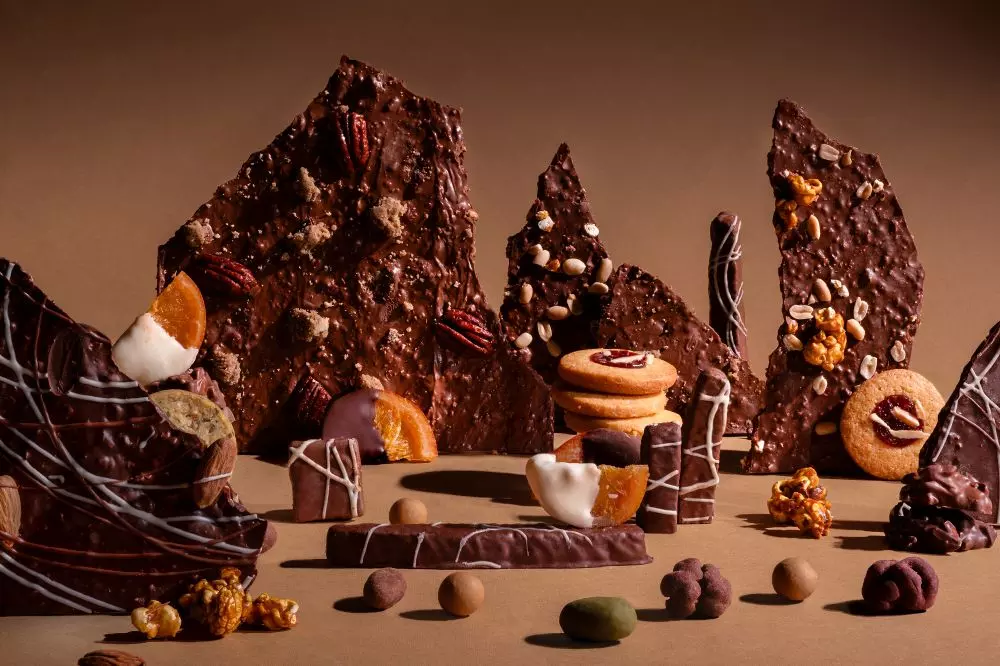
The snacking collection by Manam Chocolate. Alongside classic milk, dark and white chocolate, a new generation of bean-to-bar makers and luxury chocolatiers are experimenting with flavours that are unmistakably Indian — masala chai, gulkand, jaggery, filter coffee, millet, saffron, black pepper, paan and even festive favourites such as modak and rasmalai. Photo: By special arrangement
As India joins in celebrating World Chocolate Day on July 7, the country’s chocolate industry finds itself at an interesting crossroads.
The International Market Analysis Research and Consulting Group valued India’s chocolate market at “USD 3.05 Billion in 2025 and is projected to reach USD 5.62 Billion by 2034, growing at a compound annual growth rate (CAGR) of 7.01 per cent from 2026-2034”. Artisanal and craft chocolate was found to be the fastest-growing segment, “growing at an 11.52 per cent CAGR”.
The offerings reflect this evolution.
The shelves of premium chocolate boutiques today look very different from, say, even a decade ago. What was once considered an imported indulgence is increasingly being infused with local ingredients and memories. Alongside classic milk, dark and white chocolate, a new generation of bean-to-bar makers and luxury chocolatiers are experimenting with flavours that are unmistakably Indian — masala chai, gulkand, jaggery, filter coffee, millet, saffron, black pepper, paan and even festive favourites such as modak and rasmalai.
Yet beyond the social media buzz and gift-worthy packaging lies a larger question: are these Indian flavours creating a sustainable market, or are they merely novelty products that consumers buy once and forget?
For India’s craft chocolate makers, the answer lies not in making chocolate “Indian”, but in making it better. At Hyderabad-based Manam Chocolate, innovation begins not with the ingredient but with the cacao itself. Chef Ruby Islam, head of product & innovation, believes that local flavours should never overpower chocolate but should instead deepen its character.
“The inspiration never came from asking, ‘How do we make this chocolate more Indian?’ It always begins with the chocolate itself,” she says. Understanding the flavour profile of each cacao bean allows the team to identify ingredients that complement rather than compete with it.
This philosophy explains why Manam’s Masala Chai chocolate pairs warm spices with a malted milk chocolate whose toasted notes naturally echo the flavours of tea. Likewise, its Pistachio Fudge bar isn’t an attempt to recreate an Indian mithai but rather to evoke nostalgia through familiar textures and flavours that work harmoniously with chocolate, says the brand.
Delhi’s luxury chocolate brand Fabelle, at ITC Maurya, follows a similar path, although with a stronger emphasis on storytelling. Chef Yashita Sharma says the brand’s concept-led collections reinterpret global desserts through chocolate. From Key Lime Pie and Cannoli to Rasmalai-inspired chocolates, each creation is designed around a narrative rather than simply a flavour. During festivals, Fabelle has also introduced limited-edition chocolate modaks, merging traditional celebrations with contemporary confectionery.
The response, she says, has been encouraging. “While these flavours often attract first-time buyers because of their uniqueness and nostalgia, their familiarity and strong cultural relevance encourage customers to return time and again. We have many guests who regularly buy these options and recommend them to friends and family.”
Chocolates by Anuttama. Many argue that premium chocolate should celebrate the nuances of origin. Overloading bars with spices, flowers or sweets, they contend, risks turning fine chocolate into flavoured confectionery. Photo: Ayandrali Dutta
That repeat purchase behaviour is perhaps the biggest validation for an industry often accused of producing Instagram-friendly gimmicks.
Indeed, at Manam Chocolate, some of the company’s biggest sellers are flavour-forward creations such as Pistachio Fudge, Chai Biscuit layered with caramelised pecan crumble, and Coffee Crunch. These have evolved from experimental launches into products with loyal customer bases.
“Successful innovation isn’t about creating something that’s simply unexpected,” says Islam. “It’s about crafting flavours that are delicious and that customers reach for again and again.”
Centred on cacao
Much of this shift has been enabled by the rise of India’s bean-to-bar movement. Among its pioneers is Delhi-based Colocal, founded by Sheetal Saxena and Nishant Kumar Sinha. Their journey started not with flavour experimentation but with understanding cacao at its source.
The founders travelled extensively through Kerala’s Idukki Hills, lived among cocoa growers and studied every stage of chocolate production before launching what became India’s first live chocolate factory café.
“We did a lot of research and reached out to various roasters to understand every nuance of chocolate,” recalls Sheetal. “I stayed with the locals in Kerala to see the whole process from scratch — how cocoa is grown, sourced and processed.”
That commitment to origin has shaped Colocal’s philosophy. Their chocolates celebrate Indian-grown cacao rather than masking it, using ingredients such as organic khaand instead of refined sugar in products like The Olmecs, a 75 per cent premium cacao chocolate sweetened with unrefined cane sugar.
For brands like Colocal, authenticity begins with sourcing before flavour innovation even enters the conversation.
At Karnataka-based Anuttama, founder Swathi Kallegundi sources cocoa directly from her family’s farm and neighbouring growers in Puttur, ensuring complete control over bean quality and flavour.
“Our aim is to offer quality and healthy chocolates,” she says. “We look for graded cocoa that is grown chemical-free and as organic as possible.”
While the company remains rooted in bean quality, it has also embraced regional ingredients. Organic jaggery lends depth to several chocolate bars, while creations such as the Kheer Burst, Spicy Tang 62 per cent Dark Chocolate and have become consistent customer favourites.
The brand also reflects another growing trend in premium chocolate — sustainability. Zero-waste practices and plastic-free packaging have become as much a part of the premium chocolate narrative as single-origin cacao itself.
Not a desi overload
While most brands are reluctant to share sales figures or disclose what percentage of their total business comes from experimental flavours, industry insiders say today’s consumers are far more adventurous than they were even five years ago.
Chef Yashita Sharma attributes this to greater international travel, exposure through social media and an expanding awareness of global food trends.
“Indian consumers are far more open to exploring new flavours than they were a few years ago,” she says. “People are willing to try pairings like chilli with chocolate, provided the flavours are balanced and familiar enough for the palate.”
Chef Ruby Islam has observed a similar evolution.
“I think the Indian consumer today has a far more mature and curious palate than ever before,” she says. Diners are increasingly asking where ingredients come from, how they’re sourced and why certain flavour combinations work together. That curiosity gives chocolatiers greater confidence to innovate, she notes, provided every ingredient has a clear purpose.
Also read: 57 years after Stonewall, why equality, inclusivity still a battle for India's queer community
Still, not everyone is convinced.
Among chocolate purists, there remains concern that excessive flavouring distracts from what makes fine chocolate special—the complex notes naturally present in carefully fermented and roasted cacao.
Many argue that premium chocolate should celebrate the nuances of origin in much the same way speciality coffee celebrates terroir (the complete natural environment in which a plant is grown). Overloading bars with spices, flowers or sweets, they contend, risks turning fine chocolate into flavoured confectionery.
Fabelle Cocoa Trail. Among chocolate purists, there remains concern that excessive flavouring distracts from what makes fine chocolate special—the complex notes present in carefully fermented and roasted cacao. Photo: By special arrangement
"I was initially curious to try flavours like masala chai, filter coffee and gulkand because they felt different from regular chocolates. Some combinations genuinely surprised me and I've gone back to buy them again, especially coffee and jaggery chocolates. But not every experiment works,” says Pallavi Singh, a 37-year-old dancer and content creator. For Singh, chocolates that incorporate familiar Indian flavours are enjoyable only when they are subtle and well-balanced. “If the Indian flavour overpowers the chocolate, it feels more like eating a sweet than enjoying fine chocolate. For me, the best bars are the ones where you can still taste the cacao, while the Indian ingredient adds a layer of nostalgia rather than stealing the spotlight."
Many of India’s craft chocolatiers largely agree with this standard.
Manam, Colocal and Anuttama all say they don’t believe in adding Indian ingredients simply for marketing value. Instead, each insists that the cacao must remain the protagonist.
That philosophy may well determine whether Indian-flavoured chocolates become a lasting category or remain an occasional indulgence. Looking ahead, many believe India possesses the ingredients to create its own globally recognised chocolate identity.
Chef Yashita Sharma sees enormous potential in saffron, jaggery, black pepper and India’s regional spices. “The key lies in using them thoughtfully,” she says, “ensuring they complement the cacao rather than overpower it.”
That sentiment perhaps captures the future of Indian chocolate best. The industry’s ambition is no longer simply to imitate European traditions or produce quirky festival specials. Instead, it seeks to create chocolates that speak with an Indian accent while remaining faithful to the language of fine cacao.
If that balance can be achieved, flavours like masala chai, jaggery, filter coffee and gulkand may eventually become more than seasonal curiosities. They could evolve into India’s own signature contribution to the global world of craft chocolate—one where innovation is measured not by novelty, but by how naturally India’s culinary heritage and exceptional cacao come together in a single bite.