








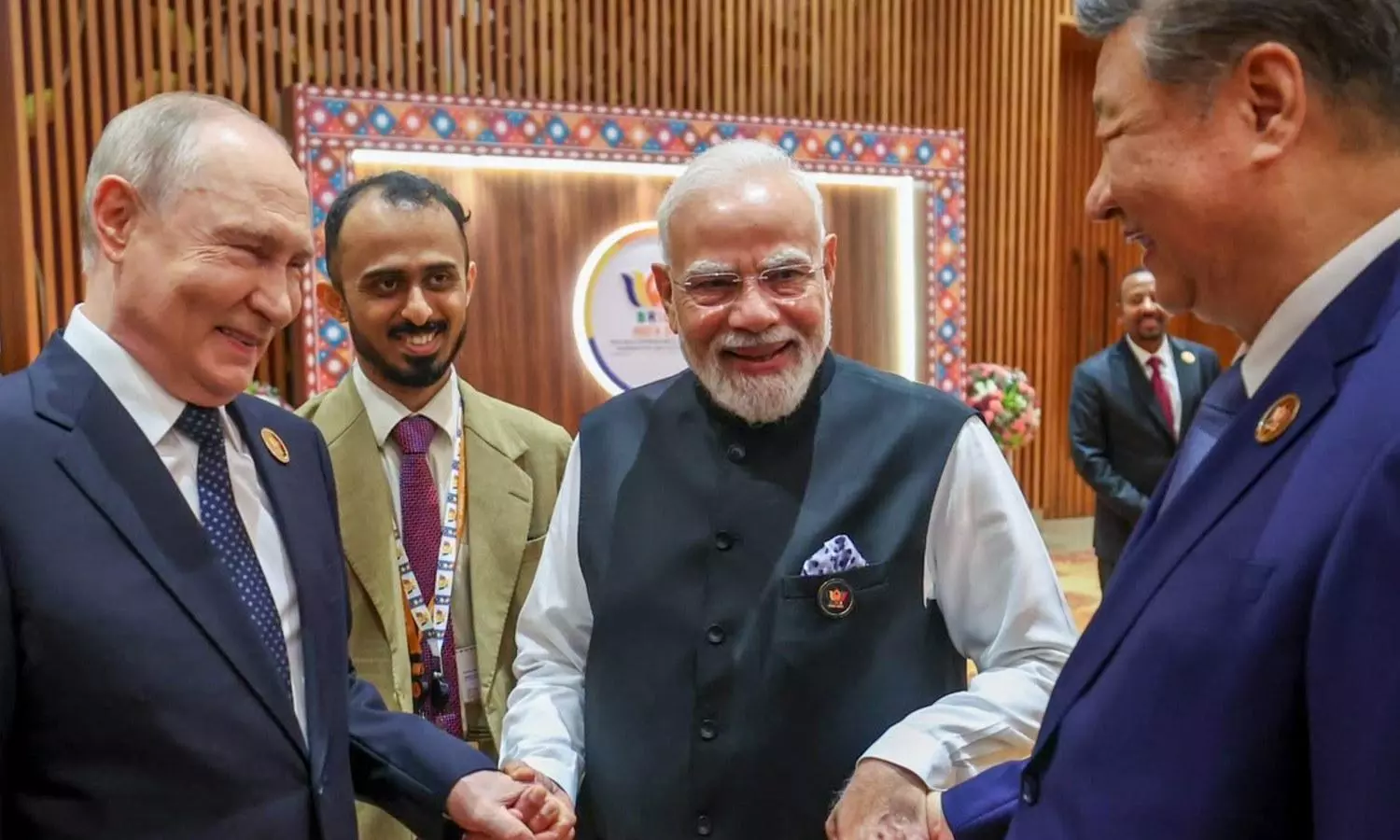
BRICS Summit Live: Xi calls for India-China unity to shape multipolar world
BRICS adopts New Delhi Declaration at end of opening day's deliberations at two-day India-hosted summit in Delhi; Modi, Xi hold bilateral meeting on sidelines

The BRICS grouping on Saturday (September 12) adopted a joint declaration with consensus, overcoming sharp divisions between Iran and the UAE over the West Asia conflict following a series of back-channel negotiations. Prime Minister Narendra Modi announced the adoption of the declaration at the end of the opening day's deliberations at the two-day India-hosted summit.
The negotiations on the text of the declaration went down to the wire as both Iran and the UAE had hardened their positions initially. BRICS is a consensus-based grouping, meaning any single member can block a final joint declaration.
Read the joint declaration here.
The two-day BRICS Summit started in New Delhi today with the theme “Building for Resilience, Innovation, Cooperation and Sustainability”. India assumed its fourth BRICS Chairship on January 1. The year 2026 also marks a milestone as BRICS completes 20 years since its establishment.
Follow live updates here.
Live Updates
- 12 Sept 2026 5:15 PM IST
Conflicts be resolved through dialogue, diplomacy: President Murmu to Iran's Pezeshkian
President Droupadi Murmu met Iranian President Masoud Pezeshkian in New Delhi on Saturday, reiterating India’s commitment to enduring peace in the region and stressing that conflicts must be resolved through dialogue and diplomacy.
Her remarks came amid escalating tensions in West Asia following fresh US airstrikes on Iranian targets and Washington’s tightening sanctions on Tehran. Welcoming Pezeshkian on his first visit to India—for the 18th BRICS summit—Murmu expressed appreciation for Iran’s support during India’s BRICS presidency.
The two leaders discussed the long-standing friendship between India and Iran, highlighting strong cultural and people-to-people ties.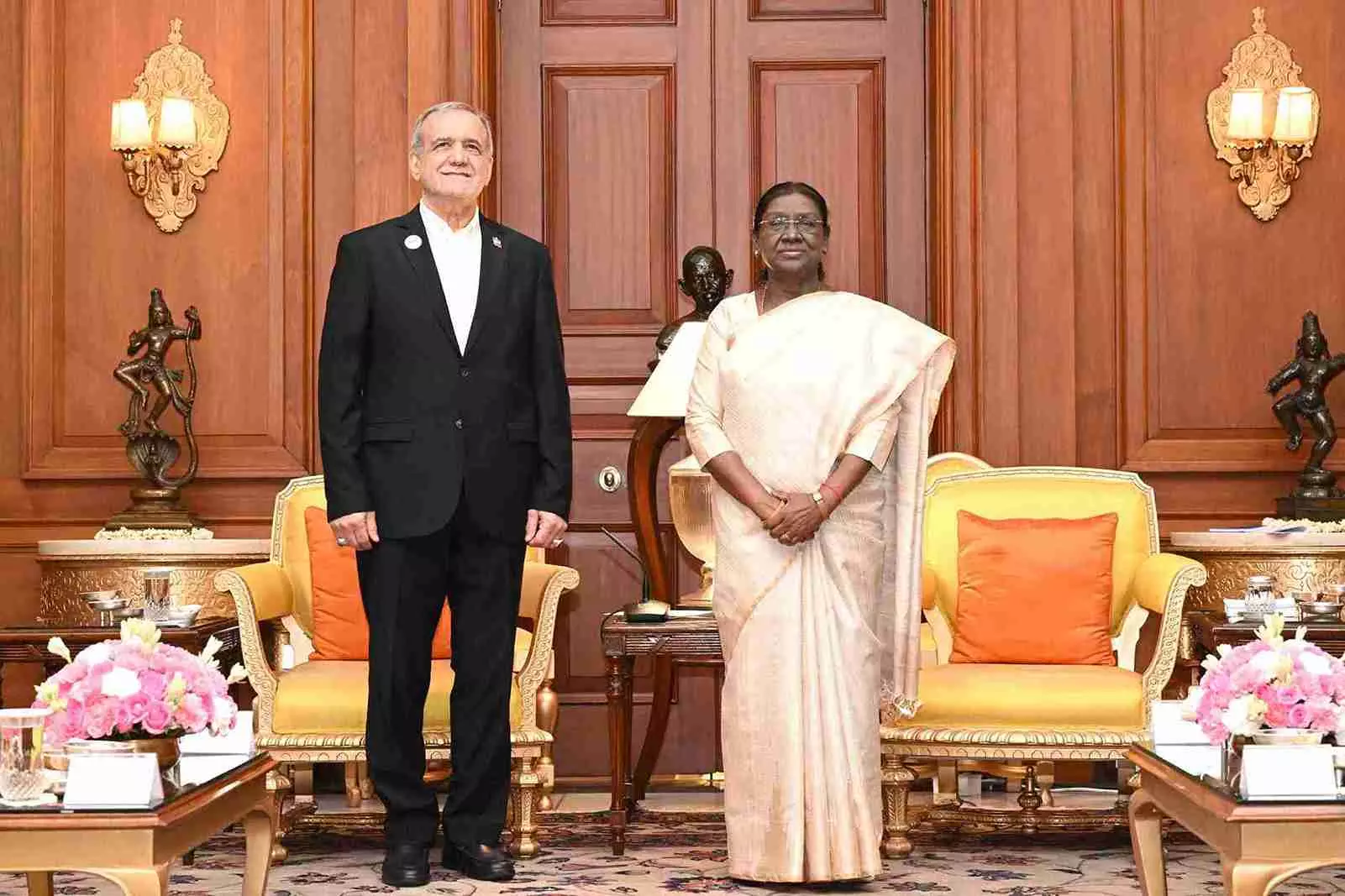
- 12 Sept 2026 5:07 PM IST
BRICS adopts New Delhi Declaration
The BRICS on Saturday adopted a joint declaration with consensus, overcoming sharp divisions between Iran and the UAE over the West Asia conflict following a series of back-channel negotiations. At the end of the opening day’s deliberations, Prime Minister Narendra Modi announced the adoption of the New Delhi Declaration, which expressed “deep concern over continued escalation of tensions in West Asia” and condemnation for the Pahalgam terror attack, among other things.
Under the theme “Building for Resilience, Innovation, Cooperation and Sustainability,” the declaration outlines the bloc’s expanded strategic partnership across three core pillars: Political and security, economic and financial, and cultural and people-to-people cooperation.
The key points of the declaration are organized under the following primary areas:
Inclusive Global Governance and Multilateralism
UN Security Council Reform: Reiterates the call for comprehensive reform of the United Nations (UN) and its Security Council. It aims to increase the voice and representation of developing countries in the Global South (Africa, Asia, and Latin America).
Global Financial Realignment: Urges immediate quota increases under the IMF's 16th and 17th General Review of Quotas (GRQ). It supports the 2025 World Bank Shareholding Review to correct the historic underrepresentation of developing economies (p. 6).
WTO Reform: Strongly backs a fair, rules-based multilateral trading system. It demands the immediate restoration of a fully functioning, two-tier binding WTO dispute settlement mechanism.
Rejection of Unilateral Sanctions: Condemns unilateral coercive measures, economic sanctions, and secondary sanctions. It notes that they severely impact human rights, development, and food security.
International and Regional Peace and Security
Counter-Terrorism: Condemns terrorism in all forms with "zero tolerance" and rejects double standards. It calls for the rapid adoption of the Comprehensive Convention on International Terrorism within the UN framework (p. 12).
Geopolitical Crises: Demands full implementation of UN resolutions for a ceasefire and unhindered humanitarian access in the Gaza Strip. It supports a just two-state solution for Israel-Palestine. It also reinforces commitment to the sovereignty and territorial integrity of Syria.
Disarmament & Cybercrime: Warns against nuclear danger and supports nuclear-weapon-free zones. It encourages nations to sign and ratify the UN Convention against Cybercrime.
Sustainable Economic Growth and Technology
BRICS Grain Exchange: Progresses the initiative to establish a shared grain trading platform to protect global food security and mitigate price volatility.
Digital Public Infrastructure (DPI): Proposes a joint repository for DPI solutions to drive digital transformation and support cross-border digital financial security.
Artificial Intelligence (AI) Governance: Commits to implementing the BRICS Leaders' Statement on the Global Governance of AI, ensuring safe, secure, inclusive, and reliable AI development.
Combatting Digital Fraud: Expresses serious concern over cross-border scam networks and organized digital fraud compounds, urging coordinated international tracing and asset recovery.
Climate, Sustainability, & Global Health
Climate & Carbon Markets: Enhances cooperation through the BRICS Carbon Markets Partnership. It highlights community-based climate adaptation using traditional and local knowledge systems.
Universal Health Coverage: Expands health surveillance and establishes a dedicated Sub-Working Group to implement the BRICS Integrated Early Warning System for preventing mass infectious diseases.
It also emphasizes shared technology to eradicate Tuberculosis.
Cultural, Labour, and People-to-People Cooperation
Cultural Preservation: Adopts the Bhopal Declaration to advance cultural industries, protect heritage in conflict zones, and prevent the illicit trafficking of cultural properties.
Labour and Employment: Launches BRICS CONNECT to forecast future skill needs in digital and green sectors while protecting the social security rights of cross-border workers.
Women and Youth Empowerment: Welcomes the BRICS Women’s Digital Capacity Building Guidelines and supports youth entrepreneurship and inclusion frameworks.
Here is the full text:
- 12 Sept 2026 3:48 PM IST
Global South must become a 'rule shaper': PM Modi
The Global South must become a “rule shaper” to deal with various challenges, Prime Minister Narendra Modi said while kick-starting the two-day annual BRICS summit on Saturday.
Modi said BRICS has established a distinct identity on the global stage and the grouping is not against anyone, remarks seen as a message to the US and other Western powers.
“Today, the Global South stands in the front row of global crises but in the back row of the decision-making process. We must transform this ‘pyramid of privilege’ into a ‘platform of partnership’—one where every nation has a voice, every member has a stake, and the development of humanity lies at the heart of every effort,” Modi said.
“In this regard, I propose that we jointly formulate 10 proposals for global governance reform, aiming to shape them into a BRICS reform roadmap by the time of the next summit,” Modi said.
He noted that this roadmap must rest on three foundational pillars:
Representation
UNSC overhaul: Modi stressed that reforming the United Nations Security Council “can no longer be delayed”. He called for ongoing text-based negotiations to be tied to a definitive timeline and tangible outcomes.
Financial institutions: He stated that voting power, leadership positions, and policy priorities in international bodies (like the IMF and World Bank) must correspond to current economic realities. As Modi put it: “Countries who give momentum to global growth should have a say in global decision-making.”
Responsiveness
Prioritising the Global South: The proposals aim to make global governance highly responsive to the actual development bottlenecks—such as food security, health, and debt distress—faced by developing nations, rather than just serving the interests of the Global North.
Rule-making
Becoming rule-shapers: Modi reiterated that BRICS must ensure developing nations transition from being “rule-takers” to “rule-shapers” in defining frameworks for emerging frontiers, including AI governance, cybersecurity, and biotechnology.
Besides these, Prime Minister Modi also underscored the vital role of the seafarer community in sustaining global trade and called for their safety to be treated as a priority. He noted that despite their massive contribution, seafarers often lack adequate support during crises.
To address this, Modi proposed the creation of a Seafarers’ Emergency Support Network. The mechanism would link maritime authorities and diplomatic missions across countries to provide coordinated assistance. It would cover distress alerts, medical aid, family notifications, and evacuations, ensuring timely help for those at sea.
- 12 Sept 2026 3:10 PM IST
Russian strikes intensify in Ukraine as BRICS balances diplomacy
Even as BRICS members in New Delhi reportedly managed to reach consensus on a joint declaration condemning unilateral wars without naming nations, Russia’s air campaign in Ukraine escalated on Saturday, killing three civilians and wounding dozens in Zaporizhzhia, Kryvyi Rih, and Odesa.
A residential high-rise in Odesa was destroyed, leaving 28 injured, while Ukrainian officials warned Moscow is deliberately targeting the power grid ahead of winter to sap morale. President Vladimir Putin, speaking at the BRICS Summit in New Delhi, cautioned that any European troop deployment in Ukraine would mean “a war with Russia,” though he denied posing a threat to Europe.
- 12 Sept 2026 2:42 PM IST
Modi’s bilateral talks focus on minerals, energy and food security
On the sidelines of the BRICS Summit in New Delhi, Prime Minister Narendra Modi held separate bilateral meetings with leaders from Malaysia, Vietnam, the United Arab Emirates, and Ethiopia, centring discussions on critical minerals, energy, and food security to safeguard trade and supply chains amid global turbulence.
In talks with Abu Dhabi Crown Prince Mohamed bin Zayed Al Nahyan, Modi reviewed the overall situation in West Asia and discussed advancing the India-UAE strategic partnership. Areas of focus included defence, artificial intelligence, space, critical minerals, energy, food security, and connectivity. Modi described the partnership as a “symbol of stability, prosperity and peace” in uncertain regional times.
With Malaysian Prime Minister Anwar Ibrahim, Modi reviewed cooperation in trade, investment, defence, semiconductors, infrastructure, digital economy, and fintech. Malaysia agreed to the establishment of an Indian consulate general in Kota Kinabalu, Sabah, while both leaders reaffirmed their commitment to strengthening the Comprehensive Strategic Partnership and ASEAN-India ties.
The meeting with Vietnamese Prime Minister Le Minh Hung focused on trade and investment, building on the Enhanced Comprehensive Strategic Partnership. Both leaders exchanged views on regional and global issues, with India highlighting Vietnam’s role as a key pillar of its Act East Policy.
Modi’s discussions with Ethiopian Prime Minister Abiy Ahmed Ali revolved around expanding cooperation in defence, trade, and capacity building. The leaders reviewed progress in strategic partnership areas and pledged closer collaboration in multilateral fora. - 12 Sept 2026 2:36 PM IST
What BRICS summit 2026 holds for each member nation
The 18th BRICS Summit centres on the theme “Building for Resilience, Innovation, Cooperation, and Sustainability,” aiming to establish the expanded 11-nation bloc as a solutions-oriented anchor for the Global South.
Amid active geopolitical conflicts—including the Russia-Ukraine war and intensifying West Asia tensions—the summit features an overarching agenda focused on reforming global financial institutions, implementing alternative local-currency payment systems, and regulating AI governance.
Here is what the summit holds for each core and newly expanded member nation:
India
The agenda: Championing the home-grown Digital Public Infrastructure (DPI) as an affordable, open-source technological template for developing economies.
What summit holds: A key balancing act. Prime Minister Narendra Modi is leveraging the platform to position India as a pragmatic, neutral mediator between the East and West, while managing critical face-to-face bilateral discussions with China’s Xi Jinping and Russia’s Vladimir Putin.
China
The agenda: Pushing for deep-tier industrial integration, promoting its “Digital Silk Road”, and accelerating cross-border economic architectures.
What summit holds: President Xi Jinping’s first visit to India in nearly seven years signals a tactical opportunity to seek normalization of economic ties with New Delhi and reinforce BRICS as a counterweight to G7-led economic containment.
Russia
The agenda: Fast-tracking alternative cross-border payment networks that operate completely decoupled from the Western SWIFT mechanism and the US dollar.
What summit holds: President Vladimir Putin’s first in-person attendance at a BRICS summit outside Russia since 2022 is a major diplomatic victory, using the New Delhi stage to show that Russia remains integrated into the economic framework of the Global South despite ongoing Western sanctions.
Brazil
The agenda: Advocating for comprehensive reforms to the UN Security Council and the Bretton Woods system (IMF/World Bank) to give emerging markets true legislative representation.
What summit holds: Represented by Foreign Minister Mauro Vieira, Brazil seeks to ensure the newly expanded bloc remains non-aligned, emphasizing green growth and climate resilience finance rather than allowing the bloc to turn overtly anti-Western.
South Africa
The agenda: Ensuring that African continental trade integration remains central to the bloc’s development goals, specifically connecting BRICS capital to the African Continental Free Trade Area (AfCFTA).
What summit holds: President Cyril Ramaphosa looks to secure investment promises for green infrastructure and build momentum for the African Union’s broader diplomatic goals on the world stage
Iran
The agenda: Securing reliable sanction-evading maritime trade routes and building regional safety guardrails amid ongoing geopolitical friction in West Asia.
What summit holds: President Masoud Pezeshkian may utilize the summit to solidify trade protection frameworks and deepen energy integration directly with major consumers like China and India.
Indonesia
The agenda: Focusing on resource nationalism, local manufacturing supply chains, and ensuring Southeast Asian economic autonomy.
What summit holds: As the newest addition to the full-member core, President Prabowo Subianto aims to establish Indonesia as a primary bridge between BRICS and ASEAN economic channels.
UAE and Saudi Arabia
The agenda: Diversifying their state investment portfolios away from Western equities into Global South infrastructure, energy grids, and AI tech corridors.
What summit holds: Actively positions the Gulf states as the primary financial and logistical hubs connecting Eastern supply chains to Western markets.
Egypt and Ethiopia
The agenda: Seeking direct liquidity relief from the New Development Bank (NDB) and establishing localized currency trades to circumvent acute foreign exchange crises.
What summit holds: An opportunity to leverage the collective power of the bloc to secure food, fertilizer, and infrastructure development guarantees during prolonged domestic inflation cycles.
- 12 Sept 2026 2:18 PM IST
BRICS secures consensus on New Delhi declaration: Report
After days of tense negotiations, BRICS members have reportedly agreed on a joint declaration that will be adopted at the New Delhi Summit. The statement condemns unilateral wars but avoids naming specific nations, a compromise designed to bridge sharp differences between Iran and the UAE over the Gulf conflict, says a Reuters report.
The summit comes at a time when wars in Ukraine and West Asia, alongside rising US-China tensions, have tested BRICS’ unity. For India, the consensus is a diplomatic win, balancing ties with Russia and Iran while maintaining engagement with the US and Europe.
The consensus on a joint statement came after intensive negotiations that went on till 4 am on Saturday. This is no mean achievement considering that getting three countries—Saudi Arabia, UAE and Iran—to agree to a joint statement seemed impossible at one point of time. Indian diplomats worked tirelessly to bridge the gap and finally got the three warring powers to sign on the dotted line.
“India led sustained consultations to bridge competing positions and build consensus among members,” sources in the government told The Federal. “India’s diplomatic prowess ensured that these differences did not derail the BRICS process,” the sources clarified.
The Modi government is patting itself on the back for what it regards as a diplomatic achievement. It is another matter that such joint statements are a short-term feel good factor that remain mainly on paper. Whatever is written in the joint statement will have little impact on the ground.
- 12 Sept 2026 1:57 PM IST
Modi-Xi talks aim to reset ties through trade and investment
Chinese President Xi Jinping’s two-day visit to New Delhi for the BRICS Summit and his impending talks with Prime Minister Narendra Modi are expected to focus squarely on normalising strained relations through expanded trade and investment. The meeting, scheduled for 6 pm on Saturday, is being seen as a chance to move beyond the shadow of the prolonged military standoff in eastern Ladakh.
Both leaders are reportedly expected to conduct a comprehensive review of bilateral ties, with emphasis on confidence-building measures and economic cooperation. The discussions are expected to cover ways to stabilise the Line of Actual Control (LAC) while simultaneously exploring new frameworks for commercial engagement. Trade and investment are being positioned as the most practical avenues to rebuild trust and inject momentum into the relationship.
Recent exchanges—including National Security Advisor Ajit Doval’s Special Representative talks with Chinese Foreign Minister Wang Yi—have laid the groundwork for this meeting. Those talks focused on frontier delimitation and sustaining peace along the border, but also underscored the need to broaden cooperation beyond security concerns.
Modi and Xi will likely seek to identify concrete steps to expand market access, encourage investment flows, and strengthen supply chain linkages. The talks are expected to balance strategic sensitivities with economic pragmatism, reflecting both sides’ recognition that trade and investment could serve as stabilising anchors in a relationship marked by mistrust. - 12 Sept 2026 1:51 PM IST
Crafts take centre stage at BRICS Culture Bazaar
The BRICS Culture Bazaar in New Delhi has become a vibrant showcase of traditional crafts, textiles, and artisanal heritage from across member and partner countries, drawing artisans from 18 nations and highlighting India’s own diverse craft traditions.
The event, bringing together over 40 artisans, designers, and creative enterprises, blends live demonstrations, installations, and exhibitions, turning the National Crafts Museum & Hastkala Academy into a global marketplace of creativity.
The exhibition features a wide spread of traditions: China’s Suzhou embroidery, Indonesia’s batik weaving, Nigeria’s wood and calabash art, South Africa’s Zulu leather craft, and Russia’s lacquer painting, among others. Each stall offers not just finished works but live demonstrations, allowing visitors to witness centuries-old techniques in practice.
India’s presence is particularly strong, with artisans such as Riyaz Ahmad (Kashmiri papier-mache), Mohammed Bilal Khatri (block printing), Karan Singh (terracotta), and Shadab Ahmed (lac bangles) showcasing their skills.
Among international artisans, Cuban artist Luis Farinas Leon, recipient of the Obra de la Vida lifetime achievement award, is exhibiting contemporary handicrafts, while Indonesian designer Yuli Astuti is credited with reviving nearly extinct Kudus batik motifs. Egyptian ceramicist Gamal Khalil Gouda Gaafar and Belarusian willow artisan Lana Slastsion add further depth to the showcase.
Beyond crafts, the bazaar includes installations, cultural performances, and interactive sessions, making it a hub for cultural diplomacy. - 12 Sept 2026 1:26 PM IST
BRICS summit faces unity test amid Iran-UAE rift
Suspense looms over the two-day BRICS summit in New Delhi as leaders struggle to forge consensus on a joint declaration, with sharp divisions between Iran and the UAE over the West Asia conflict threatening to derail talks. Negotiations are reportedly continuing “down to the wire” as both sides harden their positions, raising the possibility of a stalemate in the consensus-driven bloc where any member can block a final statement.
India, as chair, is attempting a delicate balancing act—positioning BRICS as a complementary engine of global growth while shielding the Global South from geopolitical turmoil. New Delhi has placed food, energy, and supply chain security at the heart of its agenda, aiming to insulate developing nations from the economic fallout of conflicts.
India’s chairship, guided by the theme “Building for Resilience, Innovation, Cooperation and Sustainability,” has already seen 350 meetings across 25 cities. The summit agenda spans health, agriculture, trade, technology, and disaster resilience, with leaders expected to conclude with the New Delhi Declaration—if consensus can be reached. For India, the outcome will test its ability to steer BRICS through internal divisions while projecting the bloc as a stabilizing force for the Global South.


