








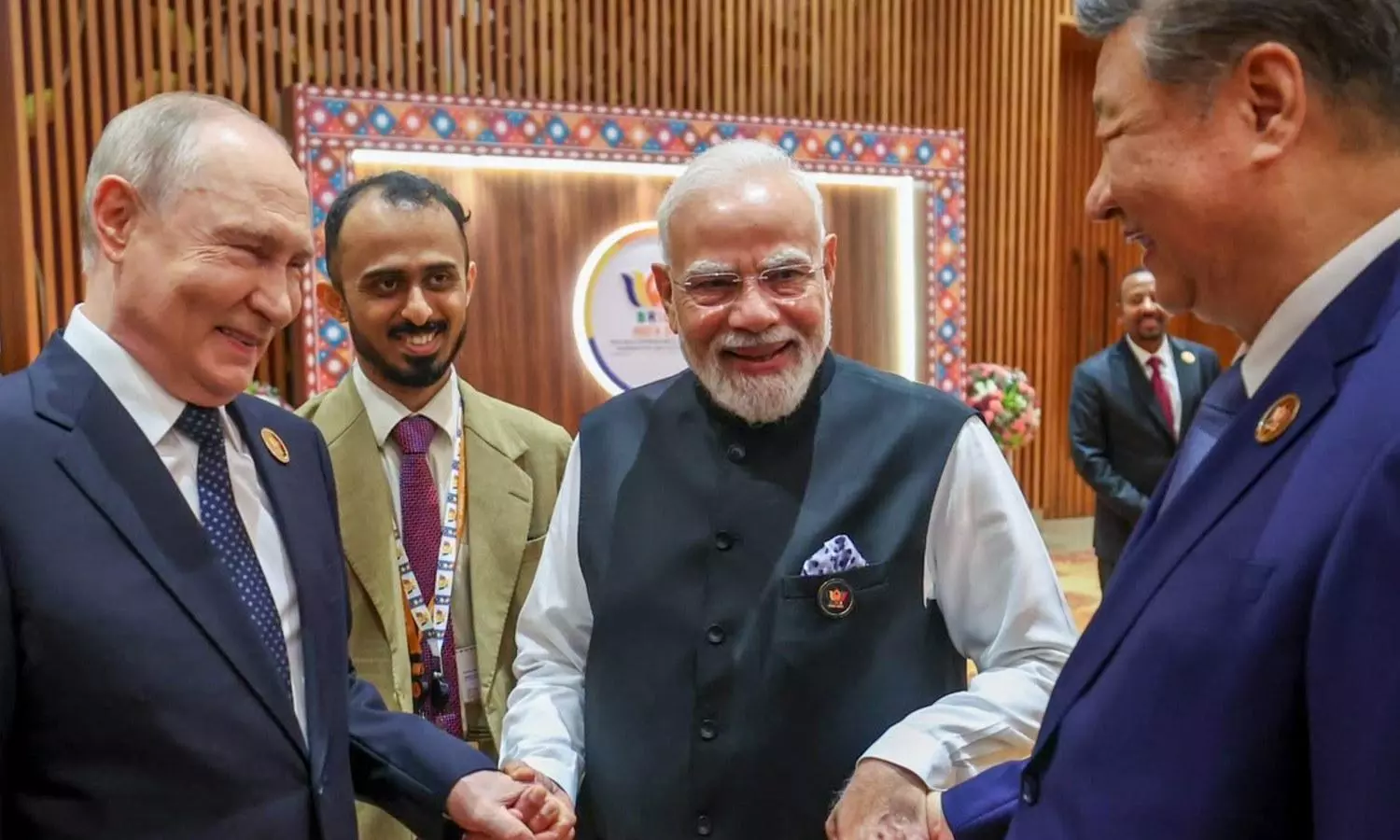
BRICS Summit Live: Xi calls for India-China unity to shape multipolar world
BRICS adopts New Delhi Declaration at end of opening day's deliberations at two-day India-hosted summit in Delhi; Modi, Xi hold bilateral meeting on sidelines

The BRICS grouping on Saturday (September 12) adopted a joint declaration with consensus, overcoming sharp divisions between Iran and the UAE over the West Asia conflict following a series of back-channel negotiations. Prime Minister Narendra Modi announced the adoption of the declaration at the end of the opening day's deliberations at the two-day India-hosted summit.
The negotiations on the text of the declaration went down to the wire as both Iran and the UAE had hardened their positions initially. BRICS is a consensus-based grouping, meaning any single member can block a final joint declaration.
Read the joint declaration here.
The two-day BRICS Summit started in New Delhi today with the theme “Building for Resilience, Innovation, Cooperation and Sustainability”. India assumed its fourth BRICS Chairship on January 1. The year 2026 also marks a milestone as BRICS completes 20 years since its establishment.
Follow live updates here.
Live Updates
- 12 Sept 2026 1:20 PM IST
Dhaka reviews 101 India pacts amid BRICS invitation row
Bangladesh has launched a sweeping review of 101 agreements with India after a diplomatic row over Prime Minister Tarique Rahman’s invitation to the BRICS Summit in New Delhi, underscoring growing tensions as Dhaka insists future relations must respect its sovereignty and national interests.
Bangladesh’s ruling BNP government announced it is reassessing 101 MoUs signed with India, citing “unethical agreements” that allegedly disadvantaged domestic interests, particularly in port operations at Chattogram. BNP chief whip Nurul Islam Moni said Dhaka would prioritize sovereignty and national welfare in deciding which agreements to retain, amend, or cancel.
The diplomatic flashpoint stems from India’s decision to invite Rahman to the BRICS Summit as chair of BIMSTEC rather than in his capacity as Bangladesh’s prime minister. Dhaka expressed disappointment, ruling out Rahman’s attendance and stressing that his first visit to India should be bilateral, not multilateral. State Minister for Foreign Affairs Humaiun Kobir said Bangladesh was working to arrange a bilateral visit “when the environment is favourable and mutual respect is maintained.”
The review comes at a sensitive time, with the 30-year Ganges Water Sharing Treaty set to expire in December. Dhaka has signalled it will deal “seriously” with matters involving national interest, including water-sharing and trade. While bilateral discussions on trade continue positively, the BRICS row has cast a shadow over ties, raising questions about India’s handling of its eastern neighbour amid shifting regional alignments.
- 12 Sept 2026 1:15 PM IST
BRICS pushes for greater voice in global finance
Under India’s 2026 chairship, BRICS finance ministers and central bank governors have renewed calls for reforms to global financial institutions, stressing the need for emerging economies to gain stronger representation, while building parallel mechanisms to bolster resilience and amplify the collective weight of emerging economies.
In joint statements issued after meetings in Jaipur and Mumbai, the bloc has highlighted its expanded membership of 11 nations, now representing nearly half the world’s population and 40 per cent of global GDP, as a foundation for greater influence in shaping economic governance.
The ministers have voiced concern over rising geopolitical tensions, trade fragmentation, protectionism, and fiscal vulnerabilities, warning that unilateral tariffs and non-tariff measures distort trade and undermine World Trade Organization rules.
Central to their message has been the longstanding demand for restructuring Bretton Woods institutions—the IMF and World Bank—to make them more representative, accountable, and reflective of today’s global economy. BRICS has backed quota realignment at the IMF and urged the World Bank’s 2025 Shareholding Review to correct historic underrepresentation of developing countries.
The grouping also emphasized strengthening its own institutions. The New Development Bank has been encouraged to expand local-currency financing, diversify funding sources, and mobilize private capital through initiatives like the BRICS Multilateral Guarantees.
Meanwhile, central banks have advanced work on the Contingent Reserve Arrangement to provide liquidity support during crises, alongside discussions on insurance, pensions, cybersecurity, and risk management.
- 12 Sept 2026 12:44 PM IST
Chinese editorial focuses on fairness, justice, and BRICS' potential
Ahead of Chinese President Xi Jinping’s visit to India, an editorial in China’s state-run Global Times framed BRICS as a vital platform for fairness, justice, and cooperation amid global turbulence, highlighting its “enormous potential” and China’s role in shaping its future.
It emphasized openness, inclusiveness, and win-win outcomes while positioning Beijing as a driver of initiatives to strengthen the Global South.
Key themes from the editorial:
Commitment to fairness and justice: The editorial argued that BRICS’ strength lies in its openness, inclusiveness, and pursuit of equitable cooperation, especially as global uncertainty grows.
China’s leadership role: It recalled Xi’s past proposals, including the “BRICS Plus” model, and stressed China’s contributions to the New Development Bank, expansion of BRICS membership, and initiatives in peace, innovation, green development, and people-to-people exchanges.
Future priorities: With China set to chair BRICS in 2027, the editorial outlined Beijing’s agenda to deepen multilateralism, align development strategies, and promote its Global Development, Security, Civilization, and Governance Initiatives.
Focus areas: The piece identified the digital economy, green development, artificial intelligence, poverty reduction, and agriculture as sectors where China seeks tangible outcomes.
The editorial concluded that a “Greater BRICS” — more united, efficient, and pragmatic — can inject stability and positive energy into a turbulent world. It portrayed BRICS not as a rival system but as a cooperative mechanism to amplify the voice of the Global South and reshape global governance.
- 12 Sept 2026 12:27 PM IST
India-China trade: A snapshot
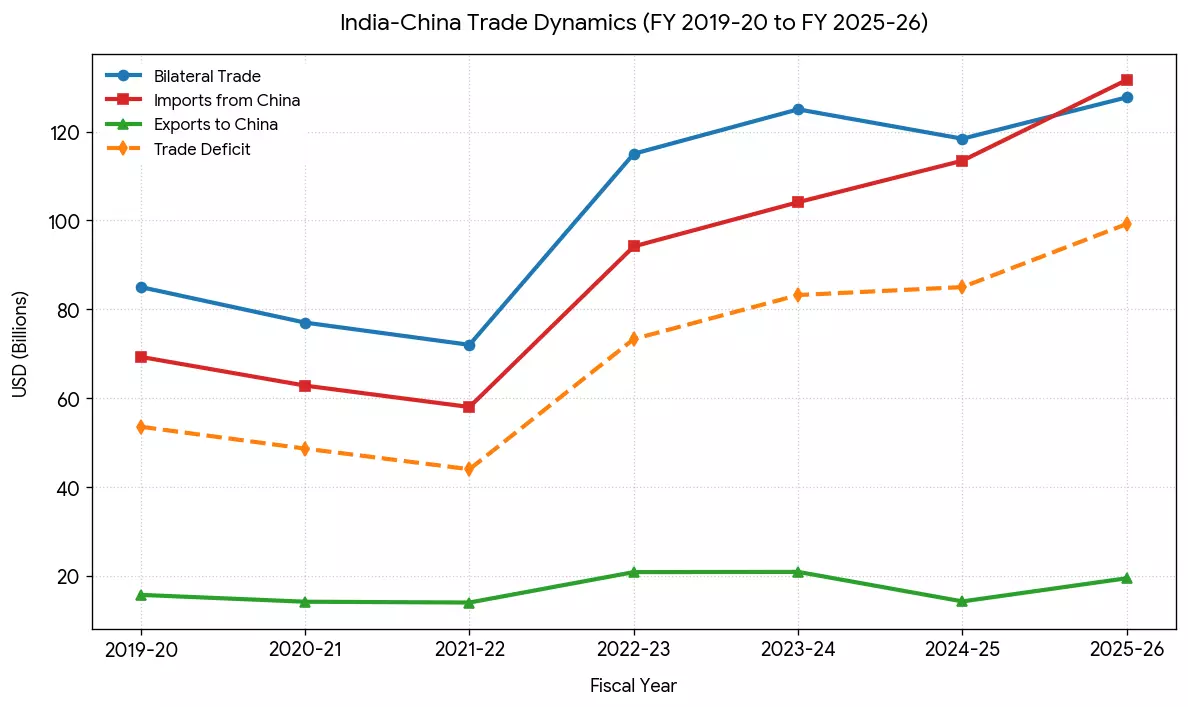
Ahead of Prime Minister Narendra Modi’s talks with Chinese President Xi Jinping, here is a snapshot of India’s trade with China (China was the second largest trading partner of India in 2025-26):
Bilateral trade: Rose 7.9 per cent in 2025-26 to USD 127.7 billion from USD 118.39 billion in 2024-25.
Trade deficit: Widened to USD 99.19 billion last fiscal from USD 85 billion in 2024-25. It was USD 83.2 billion in 2023-24, USD 73.3 billion in 2022-23, USD 44 billion in 2021-22, USD 48.64 billion in 2020-21 and USD 53.56 billion in 2019-20. According to the commerce ministry, the deficit is mainly due to imports of raw materials, intermediate goods and capital goods
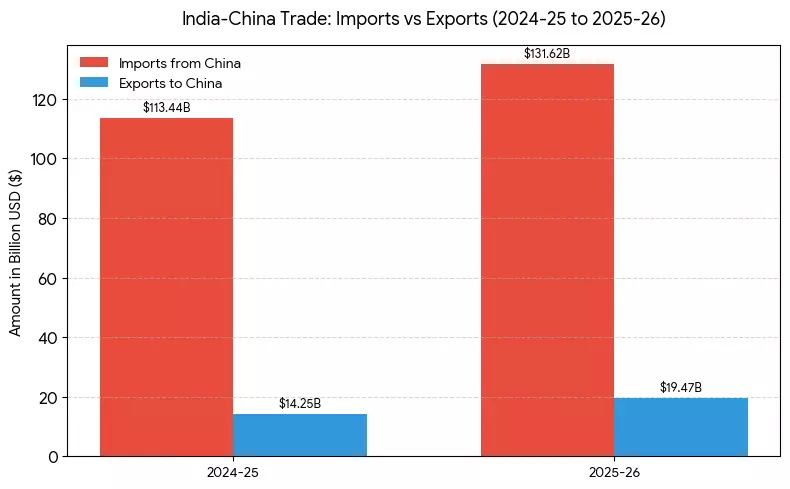
India’s exports to China: Grew by 36.62 per cent to USD 19.47 billion in 2025-26 from USD 14.25 billion in 2024-25.
India’s imports from China: Rose by 16 per cent to USD 131.62 billion in the last fiscal from USD 113.44 billion in 2024-25.
China’s share in India’s total merchandise imports: About 17 per cent in 2025-26, up from 15.7 per cent in 2024-25.
China’s share in India’s total merchandise exports: 4.4 per cent in the last financial year, up from 3.2 per cent in 2024-25.
All charts generated using AI
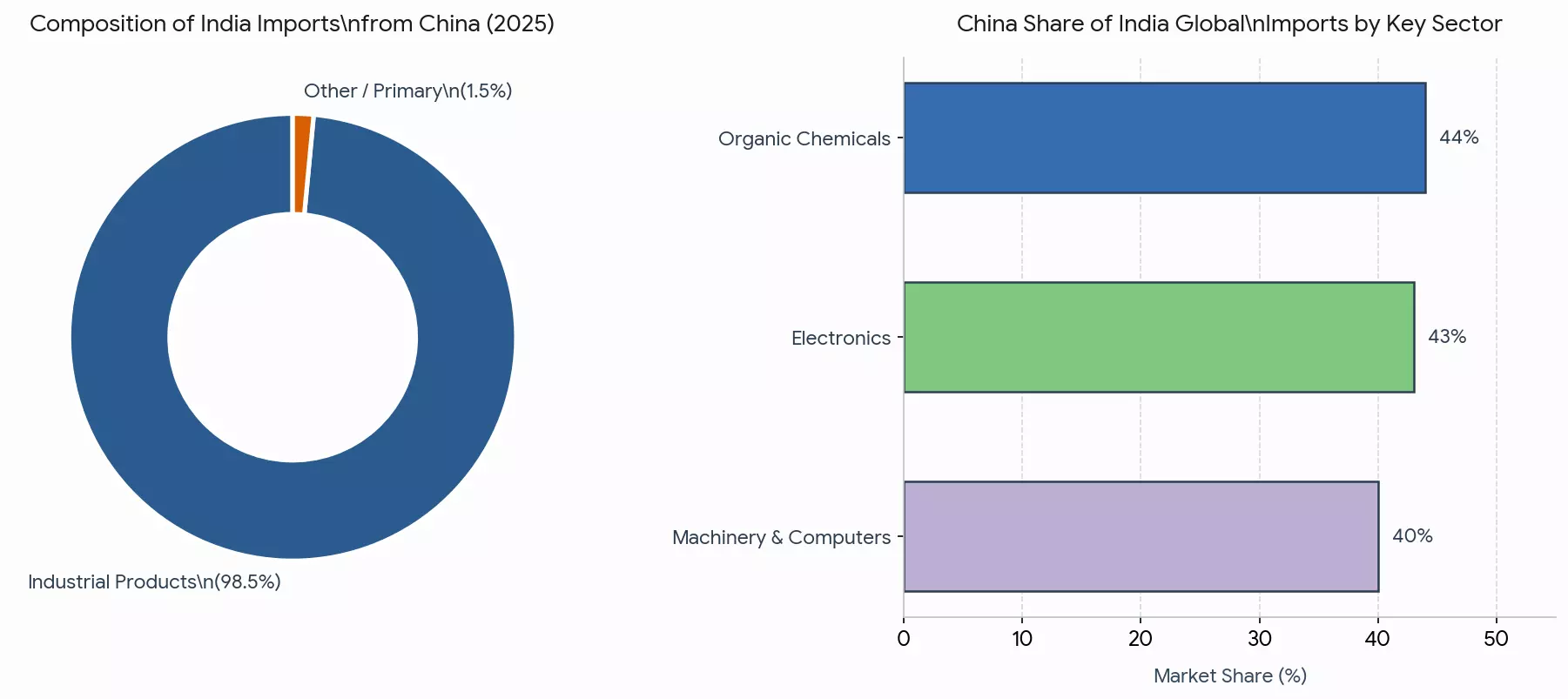
India’s dependence on China: In 2025, 98.5 per cent of India’s imports from China were industrial products, with agriculture, fuels, and gems and jewellery together accounting for less than 1.5 per cent.
About 66 per cent of India’s imports from China, valued at USD 82.6 billion, were clustered in electronics, machinery, computers, and organic chemicals.
China accounts for 43 per cent of India’s electronics imports, 40 per cent of machinery and computer imports, and 44 per cent of organic chemicals.
These imports are core inputs that feed directly into India’s manufacturing ecosystem, according to think tank GTRI. Indian industry relies heavily on Chinese inputs—electronic parts, EV batteries, solar modules, APIs and specialty chemicals—that are hard to replace at scale. Thus, even as India tries to grow exports, its supply chains remain tied to China.
Chinese investments: India has received foreign direct investment worth USD 2.51 billion during April 2000 and March 2026.
- 12 Sept 2026 11:57 AM IST
BRICS walks a fine line on dollar dependence
The BRICS bloc has once again tempered expectations of a bold move against the US dollar.
In a joint statement following a meeting of finance ministers and central bank governors, the grouping avoided mention of a common currency or outright replacement of the dollar. Instead, it reaffirmed incremental goals: Interoperable payment systems, local-currency settlements, and voluntary cooperation. The BRICS Payment Task Force was tasked with continuing work on cross-border payment solutions that are fast, low-cost, and transparent.
Yet, at the BRICS Business Forum in New Delhi, leaders struck a sharper tone. Iranian President Masoud Pezeshkian urged members to expand the use of national currencies and build instruments to manage currency risks, stressing that reliance on a few dominant currencies leaves economies vulnerable to political shocks.
For Iran, under heavy US sanctions, alternative mechanisms are vital to reduce exposure to dollar-based restrictions. Russian President Vladimir Putin echoed this, calling for a “new, sustainable platform for global growth” to counter sanctions-driven disruptions.
The joint statement also highlighted the New Development Bank’s role in expanding local-currency financing, diversifying funding sources, and supporting high-impact projects. Initiatives like the BRICS Multilateral Guarantees aim to lower financing costs and attract private capital.
However, de-dollarisation remains easier said than done. The dollar’s dominance rests on deep US financial markets, its central role in global trade and commodities, and the scale of dollar-denominated assets. BRICS members face hurdles of uneven currency convertibility, varying levels of internationalisation, and trade imbalances that complicate settlements.
- 12 Sept 2026 11:51 AM IST
Trade, defence, semiconductors part of Modi-Anwar Ibrahim talks
Prime Minister Narendra Modi on Saturday held talks with his Malaysian counterpart Anwar Ibrahim on the sidelines of the BRICS summit, focusing on boosting bilateral cooperation in sectors such as energy, defence, trade and investment.
“Building on Prime Minister Modi’s visit to Malaysia in February 2026, the leaders reviewed the progress in bilateral cooperation across a range of areas, including trade and investment, defence and security, semiconductors, infrastructure, digital economy, energy, fintech, education, tourism and people-to-people ties,” External Affairs Ministry spokesperson Randhir Jaiswal said on social media.
The leaders exchanged views on key regional and global issues of mutual interest, he said.
- 12 Sept 2026 11:47 AM IST
China Southern Airlines to resume Guangzhou-New Delhi flights
China Southern Airlines has announced that it will resume regular passenger services on the Guangzhou-New Delhi route from September 21.
The airline’s decision to restart the service comes after a six-year suspension and coincides with Chinese President Xi Jinping’s visit to India to attend the BRICS summit and hold talks with Prime Minister Narendra Modi on further improving bilateral relations.
China Southern Airlines, headquartered in Guangzhou in China's southern Guangdong province, is one of the country’s major carriers. Its services between India and China were suspended following the COVID-19 pandemic in 2020 and were not restored amid the over four-year military standoff between the two countries in eastern Ladakh, which ended in October last year.
The resumption of flights is part of the gradual normalisation of India-China relations following two meetings between Modi and Xi in 2024 and 2025. Following the improvement in ties, several Chinese and Indian airlines resumed flight services between cities in the two countries, including the Beijing-New Delhi route.
China Southern Airlines will operate more than 100 weekly flights across eight round-trip routes in South Asia, the carrier said.
- 12 Sept 2026 8:31 AM IST
Modi-Putin meet: Why India won't walk away from Russia, even under US pressure
The shadow of Washington continues to hang over India-Russia relations. As Prime Minister Narendra Modi and Russian President Vladimir Putin held wide-ranging talks on Friday afternoon (September 11), a US sanctions bill that has already cleared the Senate threatens to make the relationship much harder to sustain if it becomes law. Read the analysis here.
- 12 Sept 2026 8:27 AM IST
Why India’s electronics boom in BRICS comes with a concentration risk
As leaders of the expanded BRICS grouping gather in New Delhi, India’s electronics industry is arriving at the summit with a number that underlines both the opportunity and the challenge before the bloc: electronics exports to BRICS markets rose nearly 50 per cent in 2025-26. Read the full story here.
- 12 Sept 2026 7:53 AM IST
Xi Jinping reaches Delhi, to hold talks with Modi
Chinese President Xi Jinping arrived in New Delhi on Saturday morning to attend the 18th BRICS Summit. He is scheduled to hold talks with Prime Minister Narendra Modi on the sidelines of the summit.
Xi left Beijing on Saturday morning to attend the BRICS Summit in New Delhi at the invitation of India's Prime Minister Narendra Modi, state-run Xinhua news agency reported.
His entourage includes close associate Cai Qi, who is a member of the high-powered Standing Committee of the Political Bureau of the Communist Party of China (CPC) and director of the General Office of the CPC Central Committee, and Wang Yi, Foreign Minister and member of the Political Bureau of the CPC Central Committee, the news report said.
This is President Xi's first visit to India in nearly seven years.
Asked how China viewed the Modi-Xi meeting, Foreign Ministry spokesperson Mao Ning told a media briefing here that this will be the third year in a row the two leaders meet, after their meetings in Kazan and Tianjin.
"China will work with India to act on the strategic guidance of the two leaders, handle bilateral relations from a strategic height and long-term perspective, step up communication, enhance cooperation, properly handle differences, and be friends enjoying good-neighbourliness and partners helping each other succeed," she said.
About the BRICS Summit, Mao said it is a key platform for solidarity and cooperation among emerging markets and developing countries.
President Xi will attend and address the upcoming summit, have in-depth exchanges with other leaders on major issues, including the current international situation, the development of BRICS mechanisms and deepening practical cooperation, and put forward China's important initiatives and propositions, charting the course for the high-quality development of greater BRICS cooperation, she said.


