- Home
- India
- World
- Premium
- THE FEDERAL SPECIAL
- States
- Perspective
- Videos
- Sports
- Education
- Entertainment
- Elections
- Features
- Health
- Business
- Series
- In memoriam: Sheikh Mujibur Rahman
- Bishnoi's Men
- NEET TANGLE
- Economy Series
- Earth Day
- Kashmir’s Frozen Turbulence
- India@75
- The legend of Ramjanmabhoomi
- Liberalisation@30
- How to tame a dragon
- Celebrating biodiversity
- Farm Matters
- 50 days of solitude
- Bringing Migrants Home
- Budget 2020
- Jharkhand Votes
- The Federal Investigates
- The Federal Impact
- Vanishing Sand
- Gandhi @ 150
- Andhra Today
- Field report
- Operation Gulmarg
- Pandemic @1 Mn in India
- The Federal Year-End
- The Zero Year
- Science
- Brand studio
- Newsletter

Beyond mid-day meal debate, how the humble egg remains both comfort food & delicacy in Bengal
Affordable, nourishing and adaptable, eggs have long been Bengal's most democratic food. From the simple boiled egg, to the staple curry and the roadside egg roll, every preparation symbolises an experience and emotion. Which is why when news emerged that eggs might be removed from the mid-day meal menu in Bengal schools, the conversation quickly moved beyond nutrition and govt policy to a far more intimate discourse on identity and culture.

For generations, the phrase maache-bhaate Bangali — a Bengali sustained by fish and rice — has served as shorthand for Bengali identity. Fish undoubtedly occupies pride of place on the Bengali meal table, but ask any Bengali what they have eaten most consistently through childhood, student life, working years and family life and the answer is just as likely to be dim or the humble...
For generations, the phrase maache-bhaate Bangali — a Bengali sustained by fish and rice — has served as shorthand for Bengali identity. Fish undoubtedly occupies pride of place on the Bengali meal table, but ask any Bengali what they have eaten most consistently through childhood, student life, working years and family life and the answer is just as likely to be dim or the humble egg.
Which is why when news emerged that eggs might be removed from the mid-day meal menu in West Bengal schools — according to reports, the International Society of Krishna Consciousness (ISKCON) has been roped in to serve the food and will be providing a vegetarian diet, replacing eggs with protein sources like paneer and rajma — the debate quickly moved beyond nutrition and government policy. It touched a far more intimate nerve, that of identity and everyday food culture.
Affordable, nourishing and infinitely adaptable, eggs have long been Bengal's most democratic food. Whether served as a simple boiled egg with rice and mashed potatoes, transformed into a fluffy mamlette (as many Bengalis continue to refer to their omelette), simmered in a comforting dimer dalna (egg curry is a close translation but not quite it; like the Kolkata biryani, the dalna will mandatorily have pieces of potato in the gravy along with the egg), tucked into Kolkata's iconic egg roll, or covered under a layer of aromatic rice along with meat and potato in the Bengali’s perennially popular dish, biryani, eggs are woven into everyday Bengali life in ways few ingredients are.
"It is true that eggs are an everyday meal as well as comfort food in Bengal," says food researcher Tanushree Bhowmick, co-founder of Vrihi Foundation, an agri-food think tank dedicated to researching and elevating the country's food culture, indigenous agriculture, and culinary diplomacy. "A Bengali's love for dim is stuff of urban legend. I don't think anyone egg dish represents Bengali culinary identity — it is one for every occasion and every emotion."
For Bhowmick, each preparation evokes a different chapter of Bengali life. "Dim sheddho with salt and pepper on a winter picnic breakfast plate is pure nostalgia. One of the first dishes many of us learnt to cook after leaving home was dimer dalna. Mushy rice with mashed dim-aloo sheddho (boiled egg and potato), tempered with mustard oil and chopped onions defines comfort food, while a mamlette with khichudi is the taste of a rainy afternoon."
Also read: Why Bengal BJP govt’s Rs 50 cr Ganga erosion budget has those living with devastation sceptical
Numbers bear out the egg’s organic tie to Bengali culinary culture — India’s Basic Animal Husbandry Statistics 2025 placed West Bengal fourth among the country’s top five egg-producing states, behind Andhra Pradesh, Tamil Nadu and Telangana. According to the report, 10.72 per cent of India’s total egg production happens in West Bengal. Egg Rate Today, a website which lists the National Egg Coordination Committee’s (NECC’s) daily egg rates across Indian cities, showed the price of eggs in West Bengal on June 30 to be Rs 7.15 per piece, Rs 0.91 higher than India’s average of Rs 6.24 per piece. Explaining that prices are impacted by “several factors including feed costs, farm-level production, transportation expenses, seasonal demand, and regional trading activity”, the site added that “West Bengal has high egg consumption driven by Kolkata and surrounding urban markets”.
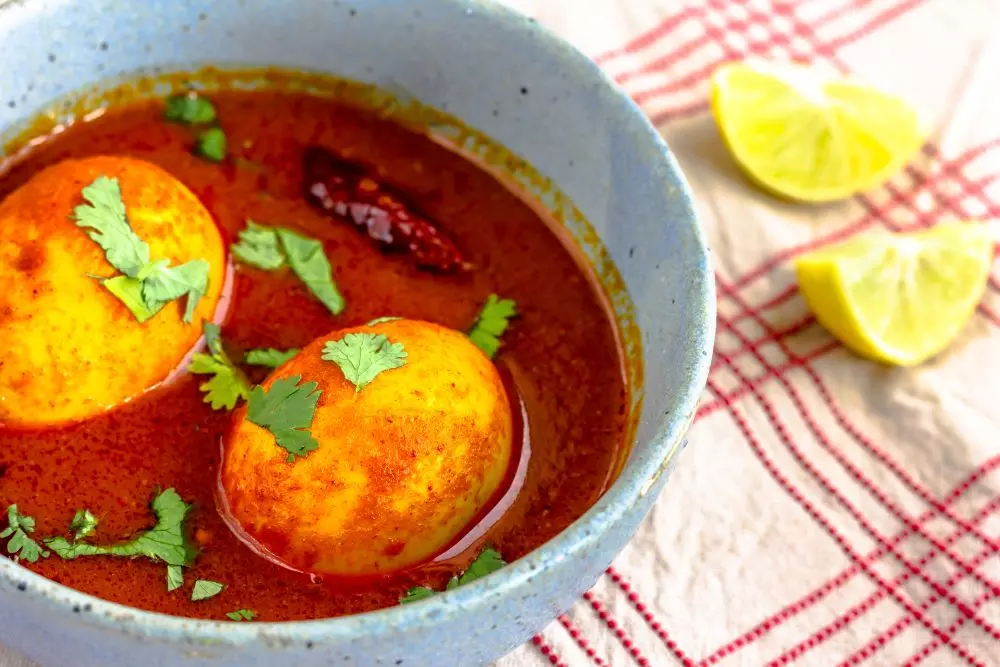
Egg Curry, the first dish many Bengalis learn to cook. Photo: Ayandrali Dutta
In most Bengali households, breakfast begins with bread and butter served with boiled eggs or fried eggs or the unmistakable Bengali mamlette — thicker than a French omelette, generously studded with onions, green chillies and coriander. Sundays, while usually reserved for a lunch of mangsho-bhaat (mutton curry and rice), also frequently bring dimer dalna — hard-boiled eggs fried until golden before being simmered in a light potato gravy fragrant with cumin, bay leaf and garam masala.
And the egg is not restricted to chicken eggs.
"We eat duck eggs too," says culinary commentator Sourish Bhattacharya. "Duck eggs have traditionally been one of the easiest sources of protein because ducks are everywhere around Bengal's village ponds."
In urban households today, haansher dimer dalna (duck egg curry) continues to be synonymous with winter delicacies.
For many middle-class families, an unexpected guest could always be welcomed with tea and a freshly made omelette if little else was available.
The egg appears just as comfortably outside the home.
Outside Kolkata's office districts, street vendors continue to sell neatly stacked boiled eggs dusted with black salt and chilli powder. Tea stalls whip up buttery egg toast within minutes.
Bhattacharya remembers watching office workers in Kolkata during the 1980s emerging from buildings in the evening and crowding around vendors selling boiled eggs or butter-laden mamlette sandwiches. "I've seen people finish work and head straight for boiled eggs or mamlette between toasted bread. Eggs were always that quick, satisfying meal before going home."
College canteens rely on egg curry as their dependable bestseller; it’s the dish political parties down the decades have used to ensure footfall at rallies.
Unlike fish, whose availability often depends on season and household budgets, eggs have always crossed economic boundaries.
"They are a democratic protein," says food explorer and strategic communication consultant Sibendu Das. "While a good parshe maach (mullet) or chingri (prawn) could easily upset a tightly planned weekly budget, the egg always remained affordable. It democratised nutrition across class lines."
Das points out that eggs have historically functioned as Bengal's culinary safety net. "Fish may define Bengal because of its rivers, but not every day brings a good catch. The humble egg is always waiting in the pantry. In rural Bengal, almost every household kept a few hens. Eggs weren't something exotic; they were literally produced at home."
Older Bengalis remember an era when even eggs were precious.
"My father grew up in a family of seven children," Das recalls. "They often shared one egg between two siblings. There was always playful bargaining over who would get the larger half."
Those memories continue to resonate because they reflect Bengal's history of food scarcity, partition (West Bengal and East Pakistan which is now Bangladesh) and economic uncertainty.
For students moving to Kolkata from small towns, eggs became the foundation of survival.
"Eggs and instant noodles fuelled generations of young Bengalis living away from home," Das says. "Cheap, quick and requiring minimal cooking skills, they helped students and young professionals establish themselves while living independently."
Bengali classics and pop culture both captured this bond, often ranging beyond chicken egg to the seemingly exotic duck, quail or turtle variants, which, for the rural population, would just be something to forage for and gather. In Rabindranath Tagore’s short story Abdul Majhir Golpo (The Story of Abdul Majhi, majhi is a boatman in Bengali), for example, the protagonist brings home hilsa and turtle eggs from the Padma River.
Recipe books down the years have dedicated entire sections to dim, be it Bipradas Mukhopadhyay 's Pak Pronali (Culinary Technique) or Praga Sundari Devi's Amish O Niramish Ahar (Vegetarian and Non-Vegetarian Food).
Also read: Why Bengal’s oft-cited cultural supremacy might be on a decline
Interestingly, however, eggs were not always accepted within Bengali Hindu kitchens.
Bhowmick notes that until the late eighteenth century, eggs remained taboo in many orthodox households. Portuguese missionary Sebastian Manrique observed in the seventeenth century that eggs were not commonly eaten among Bengali Hindus.
In Sharatkumari Chaudhurani's short story Subho Bibaho (Auspicious Wedding), consuming an egg toast was explicitly depicted as a severe moral failing and an act bordering on converting to another religion. In the 18th-century text Annadamangal by Bharatchandra Ray, the author detailed Mughal-influenced, elite Bengali dishes featuring fried turtle eggs.
"Three centuries later," she says, "eggs are firmly a part of Bengali diet and dietary imagination."
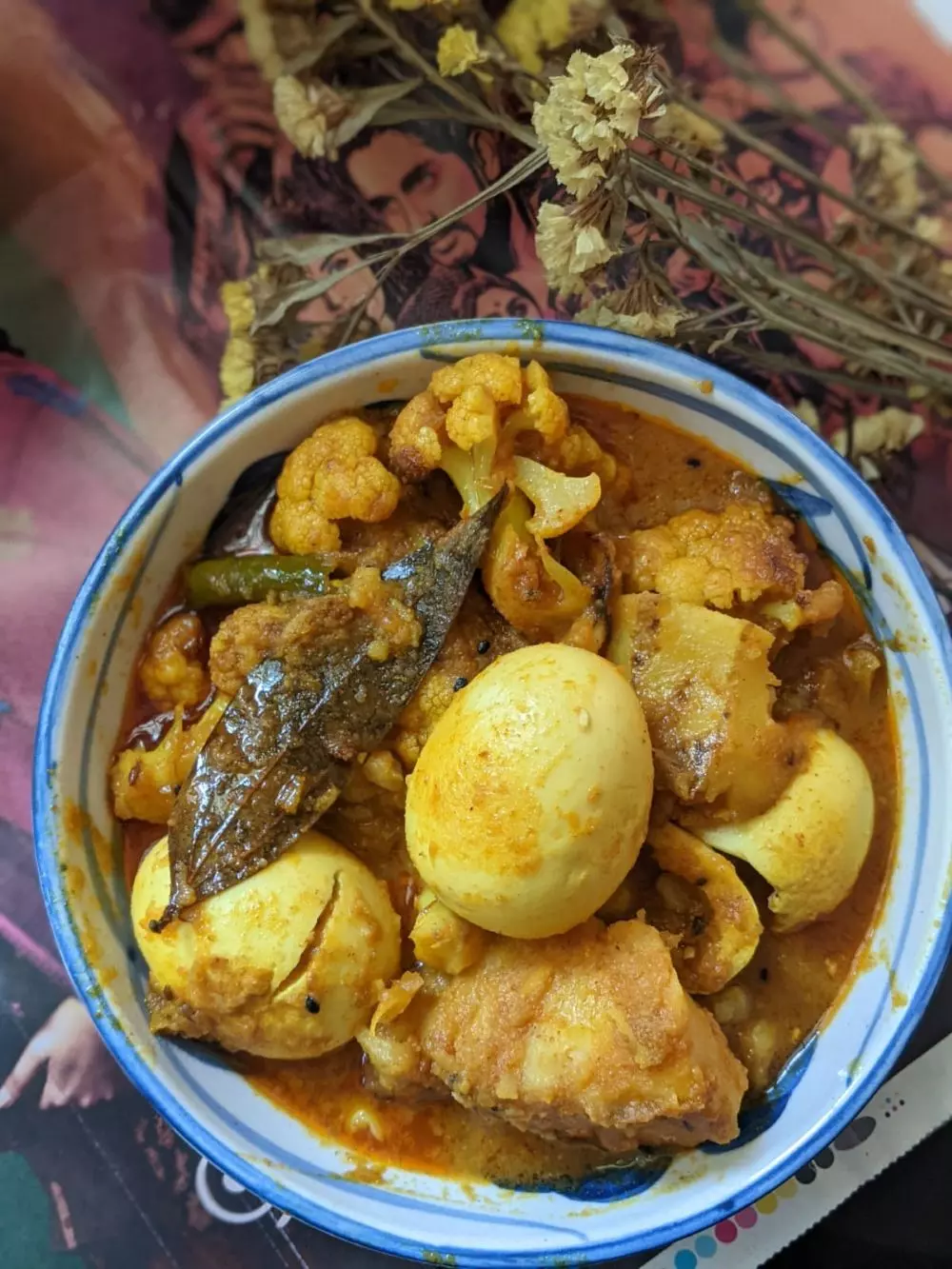
A Bengali dimer dalna, cooked with potato and cauliflower. Photo: Ayandrali Dutta.
Few food historians have documented Bengal's relationship with eggs as enthusiastically as Bhattacharya.
"Our earliest memories are linked with dim sheddhu," he says. "Boiled eggs with boiled rice, a drizzle of mustard oil and salt. Sometimes chopped onions, sometimes green chillies. Simple, nourishing comfort food. We start life with dim sheddhu, alu sheddhu (boiled potato) — food that packs protein and carbohydrates together."
Bhattacharya believes eggs are deeply embedded within Bengali culinary traditions, extending far beyond home cooking.
One example is dimer devil, Bengal's beloved crumb-fried snack inspired by the British Scotch egg.
"We decolonised the Scotch egg," he laughs. "There's the boiled egg coated with minced meat and fried. Today dimer devil is available everywhere and remains one of Bengal's favourite snacks."
More recently, the egg has quietly reshaped dishes beyond traditional Bengali cuisine. Bhattacharya recalls the famous roadside tadka dal fry, where beaten eggs were folded into Punjabi-style lentils — a local innovation embraced wholeheartedly by Kolkata diners.
Indeed, if Bengal's home kitchens celebrate eggs, Kolkata's streets elevate them to an art form.
No discussion of eggs in Bengal is complete without mentioning the city's legendary egg roll, arguably Kolkata's greatest culinary export.
Yet that is only the beginning. Egg chops, egg devil, egg toast, egg biryani, egg fried rice, egg chowmein, double-egg Mughlai paratha and double-egg rolls all form part of the city's everyday food vocabulary.
Few Indian cities have embraced eggs as enthusiastically in their street food culture. Food explorer Kaniska Chakraborty believes the egg has become inseparable from modern Bengali cuisine.
"I have two words for you," he says. "Dimer dalna. Absolute emotion. Saviour of many stretched households. Goes with bhaat as well as ruti, luchi or porota [roti, puri, paratha]. The ever-dependable, solid protein."
He adds: "Eggs are inseparable from our cuisine. They are obvious in biryani, egg fried rice, cabin culture with fish fries and chops. An entire chapter can be written about dimer devil."
For Kaniska, eggs also bridge generations.
"From dimer dalna to Eggs Benedict with poached eggs on toast, eggs feature prominently in the preferences of millennials and Gen Z along with us oldies."
His own memories are deeply personal. "I still dream about long train journeys where luchi and dim kosha were packed for meals. And no Test match at Eden Gardens was complete without bread and boiled egg for lunch."
For many Bengalis, the humble dim is more than food; it is comfort, memory and one of the state's most enduring culinary traditions. That emotional connection explains why the debate has resonated so strongly across Bengal.
Also read: Why new BJP government in Bengal has brought both hope, apprehension to Bengali film industry
Following the outcry over the mid-day meal news, there are now reports that the state’s school education department is examining the possibility of disbursing an additional amount to schools to buy and include eggs in the meal provided.
If that happens, it will be a victory not just for the humble egg, or children’s nutritional needs, but the Bengali sentiment which has wholeheartedly supported the idea of “Sunday ho, ya Monday roz khao ande [Sunday or Monday, have an egg every day]”.
Because for the quintessential Bengali, the egg has never been just another ingredient in a meal; it has been as much the hero of a satisfying spread as maach, or mutton for that matter.