World Coffee Day October 1: Why for Indian aficionados it’s time to look beyond traditional home brews
Beyond Coorg and Chikkamagaluru, India's beans and brews exploration is leading to the hills of Odisha and the Northeast—adding unfamiliar terroirs and distinctly different cups to a rapidly evolving specialty-coffee story.

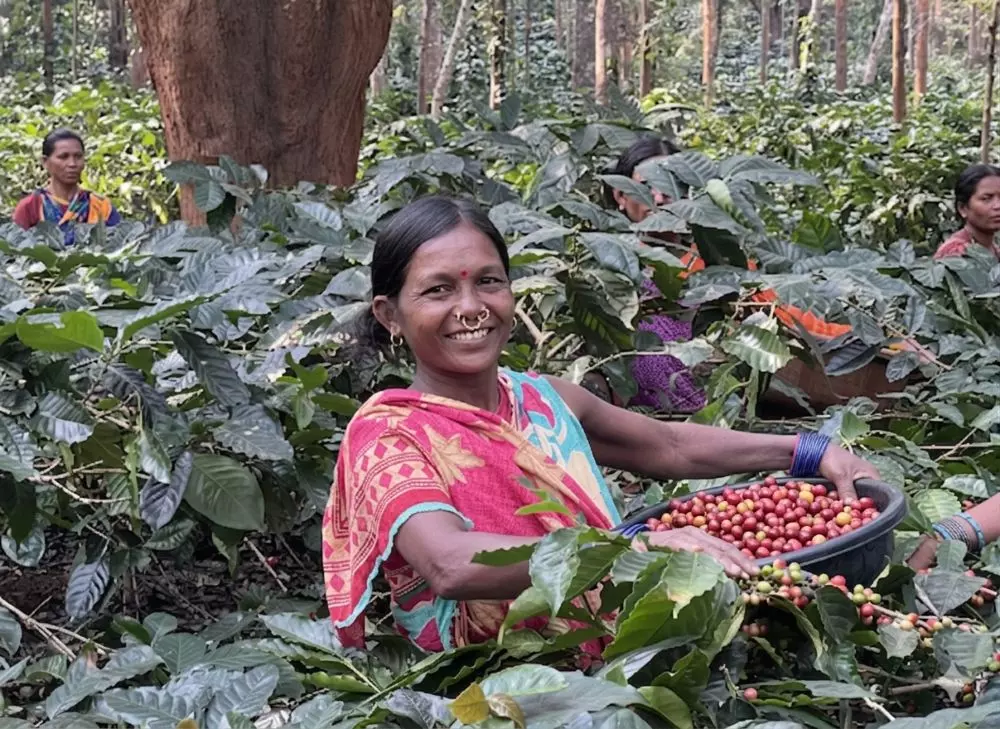
A woman collects coffee berries at a plantation in Odisha. Photo: By special arrangement
For years, the Indian coffee story seemed to begin and end in the Western Ghats. Mention “Indian coffee” and chances were that Chikkamagaluru in Karnataka or Wayanad in Keralam would be the first places to enter the conversation. And with reason.
While Karnataka accounts for the highest production of coffee in India — about 70 per cent — Keralam, at 20 per cent, comes second. These regions, along with the Nilgiris in Tamil Nadu, have earned their reputation, building generations of expertise, a strong estate culture and a recognisable identity around Indian coffee.
Interestingly though, as the number of discerning coffee consumers and the demand for specialty coffee grows in the country — India’s specialty coffee market was valued at USD 3.01 Billion in 2025 and expected to reach USD 6.52 Billion by 2031, rising at a compound annual growth rate (CAGR) of 13.75 per cent, according to reports — so has the interest in ‘non-traditional’ production areas. Two such areas that have been drawing attention with their beans and brew are the Northeast and Odisha.
In the hills of Koraput in southern Odisha, among the Eastern Ghats, coffee is being grown by tribal communities on smallholder farms. Further east and north, the mountainous landscapes of Nagaland and Meghalaya are producing coffees shaped by high rainfall, forest ecosystems, varied elevations and farming systems that often integrate coffee with other crops.
The production remains limited — against an estimated 2,56,695 metric tonnes (MT) of coffee produced in Karnataka in 2025-26, as per Coffee Board data, and 80350 MT in Keralam, Odisha’s coffee produce for the year was only 470 MT and the northeastern region’s, 220 MT. But attention is being paid to quality, processing, traceability, terroir and, importantly, the people behind the bean, say those The Federal spoke to.
As Grace Muivah, founder of Ngarum Coffee, puts it, India's coffee map is finally beginning to get bigger. The Northeast, she points out, has always had its own coffee-growing story; it simply hasn't received the same attention as the established southern regions. A specialty coffee venture, Ngarum sources single-origin, organic beans directly from small-scale growers in Northeast India, particularly Nagaland and Manipur.
A coffee map beyond the Western Ghats
Dasumarlin Majaw, founder of Smoky Falls Tribe Coffee roasters, describes the Northeast as a region where coffee has traditionally existed within a much larger agricultural landscape. In Meghalaya, for instance, coffee can be found alongside traditional crops, fruit trees, bamboo and forest vegetation rather than only in the clearly demarcated plantations associated with conventional coffee-growing regions, she says.
Also read: How the sandwich is seeing a ‘main-character moment’ in India
That distinction matters because terroir (the natural environment in which a crop is grown) is not simply altitude or soil. It is also the relationship between a crop and the landscape in which it grows — and, increasingly, the people who have learned to work with that landscape.
Muivah describes mountainous terrain, varied elevations, substantial rainfall and distinct seasonal conditions as contributing to the flavour of the coffee. Coffee is often cultivated in small plots, sometimes alongside other crops. The result can be considerable variation from one lot to another, which she sees not as a limitation but as part of the region's appeal. Ngarum coffees, depending on the lot, can show sweetness, fruitier notes and tea-like floral characteristics, she says.
Koraput: Odisha's coffee awakening
If the Western Ghats have long dominated India's coffee consciousness, Koraput offers a very different landscape.
Situated in southern Odisha, Koraput lies within the Eastern Ghats, at approximately 800 to 1,350 metres above sea level. Coffee cultivation here is primarily undertaken by tribal communities on smallholder farms, within a broader agricultural system that also includes millet, turmeric and forest produce.
A packet of specialty coffee from the Northeast. Photo: By special arrangement
According to Jeeta Mona of Kruti Coffee, Koraput's laterite-red soil, distinctive microclimate and Eastern Ghats ecosystem contribute to a coffee profile that is different from mainstream Karnataka origins. Kruti, a farm-to-cup specialty coffee roaster and cafe chain that partners directly with tribal coffee growers of the region, describes coffees from here as offering bright acidity, smooth chocolate notes and a clean finish.
There is also an important distinction in the crop itself. Mona notes that Koraput grows 100 per cent Arabica coffee, while much of the coffee grown in Karnataka and Kerala includes significant Robusta production. (In the northeast, both are grown, though Arabica dominates.)
The difficult journey from cherry to cup
Of course, producing specialty coffee outside India's established coffee belts comes with challenges.
The Northeast, particularly, has a fragmented ecosystem. Growers are spread across difficult terrain, processing infrastructure is limited and logistics can be complicated, say growers. Access to equipment, technical expertise, post-harvest processing and appropriate markets can all become obstacles.
The challenge begins at the farm itself. Specialty coffee requires ripe cherries, careful picking and precise post-harvest processing. Natural, washed and honey processes — to remove the fruit from the seed after harvest, which affects the flavour of the brew — require appropriate infrastructure, drying space, water management and technical understanding. In mountainous regions, simply moving a small quantity of coffee from a remote village to a processing unit can become a logistical exercise.
This is where the romance of the origin story meets the reality of building an ecosystem.
A different sip of India
For the coffee drinker, however, the most exciting development may be what these origins bring to the cup.
Specialty coffee is often described through an increasingly elaborate vocabulary — altitude, varietal, processing, fermentation, moisture, water activity, roast profile and tasting notes.
But there is a simpler way to understand the movement: terroir.
The concept is familiar from wine, but it is increasingly becoming central to specialty coffee. Soil, climate, elevation, shade, rainfall, agricultural practices and processing can all influence the eventual character of a bean.
Koraput's laterite-red soil and microclimate contribute to its identity. Nagaland's mountains, rainfall and small farms create another. Meghalaya's forest-rich agricultural landscape offers yet another expression.
Dushyant Singh, founder of the specialty coffee brand Coffee Sutra, says that coffees from Chikmagalur, Coorg and surrounding Karnataka belts are known for structural balance, heavier bodies and notes of roasted nuts, cocoa, stone fruits and mild spice. His observations on emerging origins point to a noticeably different sensory spectrum.
Koraput coffees can offer lighter, silky bodies, delicate sweetness, cane-sugar clarity, mild floral notes and crisp citrus characteristics. These profiles can work particularly well with paper-filtered pour-overs.
The Northeast can take the sensory journey in another direction altogether. Coffees from Nagaland, Meghalaya and the Assam hills can display vibrant acidity, berry-like notes and tea-like floral characteristics, influenced by their altitude, natural shade and temperature variations. Small micro-lots and experimental natural or wild fermentation processes can add another layer of fruit-forward complexity.
Also read: Why current times resonate with the paradox of Dickens’s A Tale of Two Cities, Auden's anxious years
For a generation of Indian coffee drinkers accustomed to choosing between a cappuccino, latte and perhaps a South Indian filter coffee, this is a significant change.
Suddenly, coffee has a sense of place. Ordering a pour-over may soon involve more than choosing a roast. It could mean choosing a landscape.
India's specialty-coffee movement is entering an intriguing phase. The next chapter isn't necessarily about discovering new places where coffee grows. It is about learning to recognise the places that have been growing coffee all along.